
Surry VADOC Supervision Release Path
VADOC administers field supervision in Virginia. A Surry court may order supervised probation instead of or after active confinement. An eligible state prisoner may leave an institution on parole after a Virginia Parole Board decision. A sentence may also include post-release supervision. Each status places the person outside institutional confinement, but none necessarily means that the sentence and supervision obligations have ended.
Riverside Regional Jail does not decide the assigned VADOC office. RRJ can document a local release or transfer. The sentencing court supplies probation terms and sentence authority. The Parole Board decides discretionary parole for eligible cases. VADOC then supervises the person through its community-corrections network. These linked records must not be collapsed into one generic release record.
A person can also leave RRJ without entering VADOC supervision. Bond release, dismissal, time served, or a completed local sentence may lead to another outcome. Confirm the court order and state status before calling any released Surry County person a probationer or parolee.
Verify Surry VADOC Supervision Records
Start with the VADOC Inmate and Supervisee Locator. Its stated scope includes probationers and parolees supervised through district offices. It also covers institutions and other VADOC placements, so the status and location must be read together. A seven-digit DOC ID is the strongest search key. The name route requires the complete last name and at least three starting letters of the first name.
- Confirm identity with the full name, birth date, and DOC ID when available.
- Search the locator and read the status and location exactly as displayed.
- Distinguish an institution from a community-supervision district or program.
- Use release papers or the locator’s named office to select the correct directory entry.
- Compare probation to the Surry sentencing order and parole to applicable Board records.
- Ask VADOC or the court for an existing record when the public result is absent or unclear.
Do not treat a blank result as proof that supervision ended. Names may differ, the person may fall outside public display, or a record may have changed. Likewise, community placement confirms release from an institution but not completion. The broader Surry County release search helps route RRJ-only, court, state, and federal custody questions.
Note: VADOC says locator data is updated daily and may change, so a dated document can still be necessary for an official historical answer.
Surry VADOC Office Assignment
The reviewed VADOC office-directory entries did not identify a district whose published service area expressly includes Surry County. Geography is not proof of assignment. A nearby district can serve a different set of localities, and an individual case can involve transfer or interstate supervision. No Surry office should be named without a live record or agency confirmation.
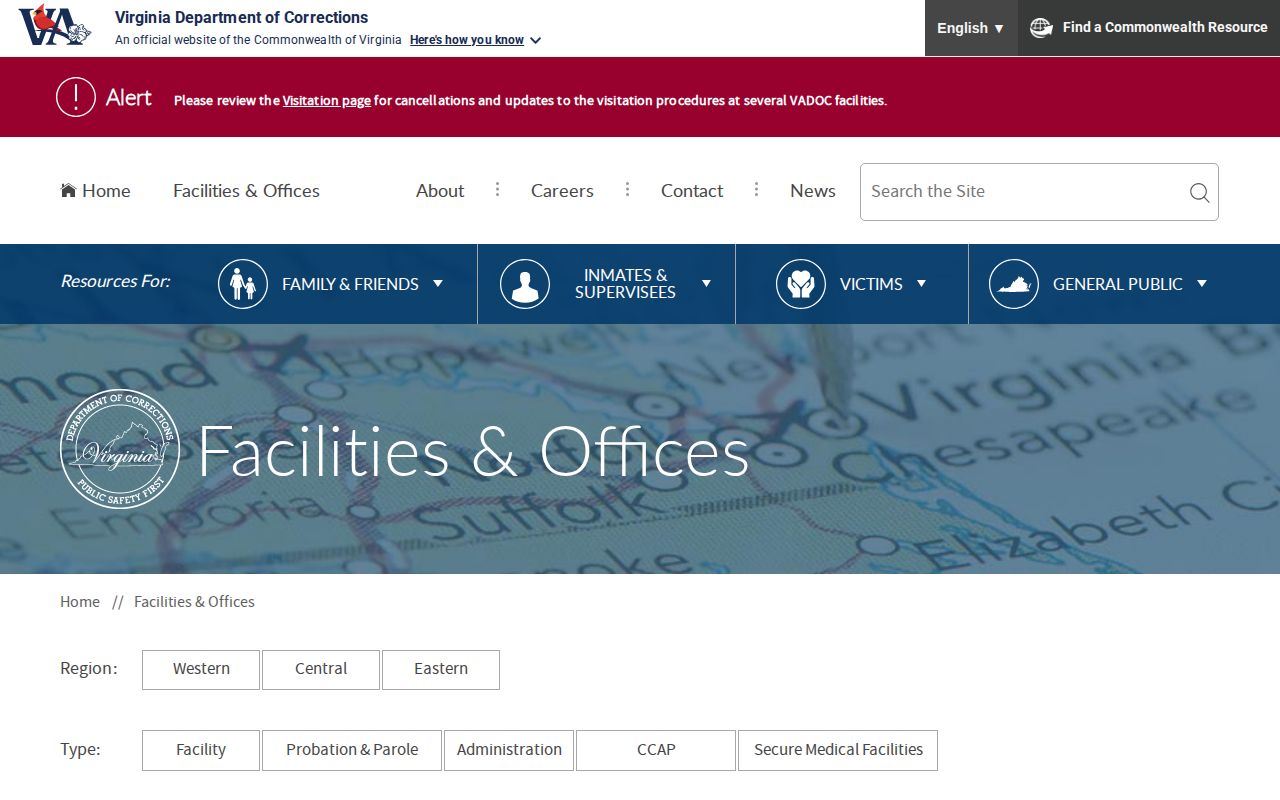
Use the district or location shown in the person’s locator record, release documents, or instructions from the supervising officer. If those materials are unavailable, call VADOC’s central number and ask how to confirm the assigned community-supervision district. After confirmation, use the Facilities and Offices directory for the office’s published address and telephone.
The official directory is shown in the image captured from the VADOC office finder.
VADOC Central Office
P.O. Box 26963
Richmond, VA 23261
(804) 674-3000
Ask for help confirming the assigned probation and parole district.
Surry VADOC Release Statuses
Parole, probation, and post-release supervision are related forms of community supervision, not interchangeable labels. The authority and timing differ. A release record should use the term found in the controlling order, Board action, or VADOC record.
| Status | Who authorizes it | What the record means |
|---|---|---|
| Parole | Virginia Parole Board | Conditional release from an eligible prison sentence |
| Probation | Sentencing court | Community supervision instead of or after confinement |
| Post-release supervision | Sentence and governing law | A supervision component following release |
| Institutional release | Custodian under sentence authority | Physical confinement ended, possibly into supervision |
| Discharge | Court or responsible agency | Custody or supervision obligation formally ended |
A suspended sentence is time the court imposed but did not order served at that point, subject to its terms. It is not time physically spent in custody. A revocation can return some or all suspended time to active status after due process. The actual order, not a summary label, determines the legal result.
- Absconder
- A person alleged to have left supervision or stopped reporting without authority.
- Capias
- A court process directing that a person be taken into custody.
- PB-15
- An officer arrest warrant referenced by VADOC for supervision enforcement.
- Discharge
- The recorded end of supervision, distinct from prison or jail release.
VADOC Parole Release Decisions
The Virginia Parole Board is separate from VADOC field supervision. Its public-meetings page is the official event calendar, not a release schedule. Under the process described since July 2024, the Board meets by videoconference with a person when it is inclined to grant discretionary or geriatric release, and the agenda is posted at least three working days beforehand. Not every parole-eligible person appears at a listed public meeting.
The Board’s parole-reports page publishes monthly decision PDFs and a five-year archive. Reports post after required notifications, at the end of the following month. They can include DOC number, case type, decision and certification dates, jurisdiction, offenses, sentence data, reasons, and votes. Outcomes include Grant, Revoke, and Continue on Parole, while denial and deferral also occur in the process.
A grant does not establish the hour of release. VADOC planning, certification, conditions, and required notices occur before departure. Confirm the release through VADOC status or documents, then confirm the assigned supervision office separately.
Eligibility is sentence-specific. Va. Code § 53.1-165.1 abolished discretionary parole for most felony offenses committed on or after January 1, 1995, subject to defined exceptions. Va. Code § 53.1-151 governs legacy eligibility with different commitment, life-sentence, and serious-offense rules. Do not calculate eligibility from sentence length alone.
Surry VADOC Supervision Record Limits
Public status does not make a full supervision file public. Va. Code § 2.2-3706(B)(6) gives custodians discretion over records of state or local law-enforcement agencies relating to probationers, parolees, and people participating in home electronic incarceration. A locator may show the broad supervision fact while an officer’s schedule, residence detail, treatment information, conditions, and case notes remain restricted.
VADOC’s Most Wanted page is also a selective list. It is not a complete warrant-search tool. VADOC explains that officer warrants, court capiases, and Parole Board warrants are filed with law enforcement. Absence from the public list does not establish that no warrant exists. Someone checking their own status should contact counsel, the assigned office, or the relevant court. The public should not attempt apprehension.
Virginia VINE is designed for local and regional jail custody events and does not track the complete probation or parole case. VADOC’s NAAVI program is a separate eligible-victim notification system for state custody and parole events. Neither notification system replaces the supervising office or court record for current conditions.
Note: Ask only for the status or existing record needed to verify supervision, and leave protected schedules and case details with the responsible parties.
Surry VADOC Supervision Discharge
Discharge answers when the supervision duty ended. It is not the same as the earlier date a person left RRJ or a state institution. VADOC’s probation and parole information says that successful completion can be followed by separate processes involving pardon, clemency, or restoration of civil rights through the Secretary of the Commonwealth. Those processes do not replace the discharge record.
Look for a discharge order, letter, court entry, or agency record. If the locator still shows a community placement, do not infer discharge from the age of the original case. If the public record disappears, ask the custodian for the existing historical entry. A person can finish supervision while the conviction and court docket remain.
For a probation case, the Surry sentencing court can explain its own order and later court action. For parole, the Board record supplies decision context while VADOC documents supervision. The Surry parole and probation page compares these verification paths in more depth.
VADOC Supervision Records Contact
A focused record request should identify the person, DOC ID when known, relevant supervision period, and the exact existing item sought. Possible records include a broad status entry, discharge letter, Order of Release, or other document maintained by the responsible unit. VADOC may withhold or redact material under Virginia law, particularly protected supervision details.
Virginia Department of Corrections
P.O. Box 26963
Richmond, VA 23261
(804) 674-3000
FOIA questions: FOIA@vadoc.virginia.gov
(804) 963-2953
Virginia Parole Board
Use the Board’s official contact page
Send Board decision and Board-record questions to the Board, not VADOC merely because both concern parole.
Virginia FOIA generally asks that an existing record be described with reasonable specificity. An agency need not create a new answer or calculate a custom discharge date. Ask for electronic production and a cost estimate. No flat supervision-record fee was established. When the issue is office assignment rather than a document, use VADOC’s main number and directory rather than a broad records request.