
Surry County Release Routes
Surry County does not operate the adult jail path shown on many county sites. The Surry County Sheriff makes arrests, serves court process, and keeps sheriff-created records. Adults who enter jail custody through Surry are generally housed by Riverside Regional Jail, known as RRJ, in North Prince George. RRJ is the first custodian to check for a local booking and the end of that booking episode. A Surry County released inmate normally drops from a current-custody view, but RRJ also supplies an Include released inmates choice in its database search.
Release has more than one meaning. A person may leave RRJ on bond, after time served, when charges are dismissed, under a court order, or at the end of a local sentence. Someone may instead transfer to the Virginia Department of Corrections, the U.S. Marshals Service, or immigration custody. Transfer ends one jail episode without returning the person to the community. State prison release may lead to probation, parole, post-release supervision, or full discharge. The wording and the next custodian decide which record confirms the event.
- Bond
- Release under court-set conditions while the case continues.
- Time served
- Confinement credited toward a sentence, subject to any other hold.
- Discharge
- The end of a custody or supervision obligation, depending on the record.
- Transfer
- A change of custodian, not proof of community release.
Surry County Release Meanings
The release type tells a reader where to look next. RRJ may document a custody-ending transaction, while the Surry court record explains the legal order behind it. VADOC has a separate record for a state commitment or later supervision. Federal and immigration systems answer still different questions. Treating all of these events as one generic release can hide an active hold or a new custodian.
| Record wording | What it means | Next check |
|---|---|---|
| Bond or recognizance | RRJ custody may end after conditions are met. | Surry docket and RRJ episode |
| Time or sentence served | The imposed local confinement has been credited or completed. | RRJ record and sentencing order |
| Probation or parole | Confinement ended, but supervision may continue. | VADOC locator and assigned office |
| Dismissed or court ordered | One legal basis for custody ended; other holds may remain. | Correct Surry court case plus RRJ |
| VADOC, USMS, or ICE transfer | Another authority took custody. | The receiving agency's official system |
A database code should not be guessed from everyday language. If RRJ returns a disposition code, ask Records for its existing definition. A past released episode also does not prove present freedom because the same person may have a later booking. Compare dates, identifiers, and the latest event before drawing a conclusion.
Surry County Release Record Fields
There is no single universal release certificate. For an RRJ episode, the useful set combines the booking record with the custody-ending entry. For a state sentence, VADOC keeps offender, sentence, time-computation, release, and supervision material. A court docket shows the order and disposition, but it is not a jail movement log. The strongest answer usually matches two sources.
| Requested field | What it can establish |
|---|---|
| Identity and booking number | Connects the response to one booking episode rather than a common name. |
| Booking date and agency | Shows when and through which authority the jail episode began. |
| Charge or holding agency | Identifies the legal or custodial route that may control release. |
| Release date and time | Records when that custodian ended the episode, if maintained. |
| Disposition or destination | Distinguishes community release from transfer or another outcome. |
| Supervision or DOC status | Shows whether a state obligation continued outside prison. |
RRJ has not published every detail field, its update cycle, or how long released results remain online. The field table therefore describes what to request, not a promise that every item appears on the web. A booking photograph is a separate record even when an agency displays it with booking data. For official proof, request the existing entry from the agency that created it.
Request Surry County Release Records
Send each request to the actual custodian. RRJ maintains regional-jail booking and release transactions. The Surry County Sheriff keeps sheriff-created arrest and incident records. VADOC handles state prison, release, and supervision files. Virginia FOIA does not require a special phrase or a stated reason, but it does require enough detail to identify existing records. Narrow wording also reduces search time, cost, and exemption review.
- Name the person, aliases if known, date of birth, and a booking or agency number when available.
- Identify the approximate booking period and ask for the booking sheet, custody-ending date and time, disposition or destination entry, and code definition.
- Ask for an electronic copy and a cost estimate before production. Virginia law permits actual reasonable production costs.
- Send RRJ jail-record requests to its Office of Professional Review at RRJ's official contact route. Route sheriff-created material to Surry County.
- Compare the response with the court order, VADOC status, or VINE event when the custody route crossed systems.
Lt. C. Jones, Office of Professional Review
500 FOLAR Trail
North Prince George, VA 23860
foia@rrjva.org
(804) 524-6600
Under Virginia's Freedom of Information Act, a public body ordinarily responds within five working days by producing the records, citing a basis to withhold, producing part, or invoking an additional seven working days when production is impracticable. It need not create a new report or answer a question. An estimate above $200 may require a deposit.
Surry County Record Access Limits
Virginia FOIA starts with a presumption of access, but criminal and corrections records fall into several categories. Va. Code § 2.2-3706 addresses basic adult arrest information and routine initial-intake booking photographs, while other investigative, imprisonment, and supervision files may be discretionary. Sealed or expunged law-enforcement records cannot be disclosed except as law permits. Juvenile information has stricter limits and must not be routed through an adult inmate search.
The GS-08 schedule identifies cumulative booking and release records with a twenty-year retention after separation and certain inmate-incarceration materials with a three-year period. The correct series depends on the actual record. Use those schedules to ask whether a historical record still exists, not to claim that an online released result must remain visible. Virginia sealing law was changing around the research date, so the live statute and the date tied to the case control.
Surry Release Search Identifiers
RRJ's released search has a distinctive second route. Besides first name, last name, and date of birth, the form accepts booking, permanent, state, county, FBI, and ICE numbers. These six identifier families can separate people with similar names and connect one episode to an arrest, court, or later custody record. Search ten returned entries at a time and narrow the result before treating it as a match.
An identifier is a key, not a legal conclusion. An ICE-number option does not establish that RRJ has an immigration contract, that ICE holds the person, or that an immigration release occurred. Likewise, a state number can help find a VADOC record without proving that the person was physically transferred. Open the matching episode, compare birth data and dates, then read the actual disposition.
Note: Never identify a Surry County released inmate from a common name or photograph alone; compare record numbers and chronology.
Find Surry County Released Inmates
The official search begins with custody, not a broad name query. RRJ is the adult local-jail route. VADOC covers state institutions and community supervision. BOP covers federal prison records, ICE covers current civil immigration detention, and the Surry courts explain local legal orders. Each channel has a different scope.
- Open the RRJ Inmate Database Search and enable Include released inmates.
- Search by name and birth date, or use a known booking, permanent, state, county, FBI, or ICE identifier.
- Read the matched episode literally. Leaving RRJ may mean release, transfer, escape, death, or a data change.
- Check Virginia VINE for the same person and participating jail. Treat release and transfer notices as distinct events.
- Use the correct Surry General District or Circuit Court docket to read bond, disposition, sentence, and later orders.
- If a state commitment appears, move to VADOC. Use BOP, ICE, or the federal docket only when that custody context exists.
- Request the custody-ending transaction from RRJ Records when online sources remain unclear.
Match the evidence to the event. A bond release is strongest when the RRJ disposition aligns with the Surry bond order. A state transfer is strongest when the RRJ episode aligns with a VADOC entry. Federal history belongs with the federal docket, not a county roster.
VADOC Surry Release Lookup
The VADOC Inmate and Supervisee Locator is broader than a prison roster. It covers state institutions, people on community probation or parole, institutional hospitals, Community Corrections Alternative Programs, and some state-responsible people still in local or regional jails. The service says it updates daily and warns that facts may change. A state-responsible Surry case can therefore appear before physical transfer and after institutional release into supervision.
| Search field | How it works | Match value |
|---|---|---|
| DOC ID | Seven-digit state identifier | Best direct match when known |
| First and last name | At least first three letters plus full last name | Narrow common names carefully |
| Location, race, sex, age | Optional filters | Support identity checking |
| Status or location | Read exact live result wording | Distinguishes confinement from supervision |
The live locator field for a future release date was not verified during research because access controls prevented a clean result check. Do not invent a label. A projected or anticipated date is an estimate, not the event itself. Community-supervision placement supports the conclusion that institutional custody ended, but it does not mean the sentence or supervision has ended.
The official VADOC locator image shows the statewide channel used when a Surry case becomes state responsibility. Visit the VADOC locator source before relying on its current fields.
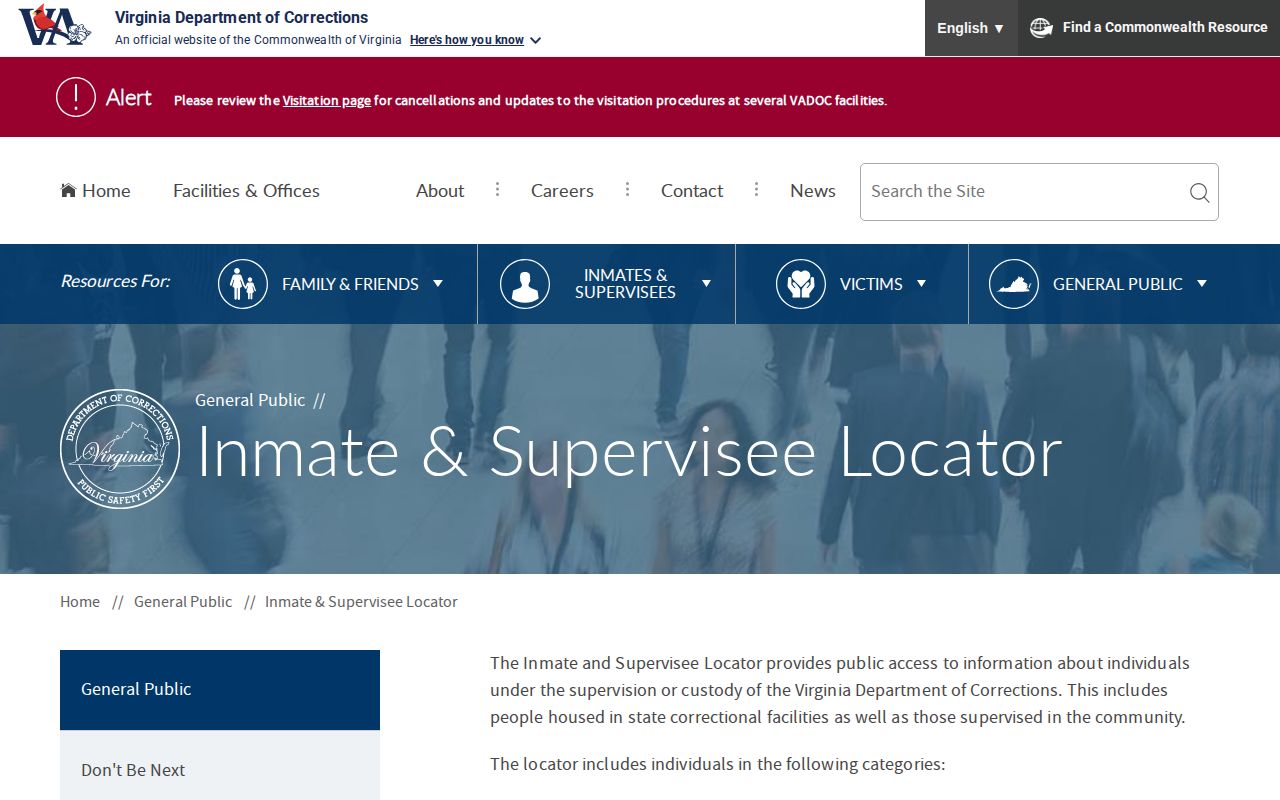
The locator complements RRJ. It does not replace the regional jail record for an ordinary local detainee.
Surry Court Release Timing
Surry's General District Court publishes a Monday criminal calendar with arraignments and bond hearings at 8:30 a.m., video advisements at 10:30 a.m., and trials at 11:00 a.m. Those hours explain when an order may originate. They do not state when RRJ will finish release processing. Staff still must receive the order, confirm conditions, and check every other hold.
Question: Does a bond order prove release? No. It authorizes release after conditions are met, and another charge, detainer, or custodian may still prevent community departure.
Surry Criminal Court Record Layers
Surry has two adult criminal-record layers. General District handles misdemeanors, preliminary felony proceedings, arraignments, and bond events within its authority. Circuit Court handles felony trials, sentencing, appeals from district court, and later orders. Select Surry in the relevant Virginia court information system. A docket may explain why custody could end, but only the jail record timestamps the actual departure.
Public online Juvenile and Domestic Relations information is restricted and must not be folded into the adult release path. The circuit search also requires selecting the correct locality rather than assuming that one result covers every Virginia court.
Surry County Recent Release Records
Neither Surry nor RRJ published an official fixed 24-hour or 72-hour feed in the channels reviewed. RRJ instead offers a released-inclusive person search with no published web-retention window or update cadence. It is useful for a named person, but returned historical episodes must not be advertised as a complete list of everyone released today or over a weekend.
For a recent event, enable the released option, compare dates only when the result actually displays them, and then check VINE or Records. RRJ's FAQ says the jail does not provide release information to the general public and that incarcerated people receive their dates and arrange release plans. A call may route a record request, but it does not promise disclosure of a future time. The Surry released-last-24-hours method explains this no-feed fallback without manufacturing a list.
Surry County Release Supervision
VADOC administers field supervision, while the Virginia Parole Board decides discretionary parole matters. Probation is ordered by a court. Parole is conditional release for an eligible sentence. Post-release supervision is a separate sentence component. Each means confinement may have ended while legal duties remain.
Search the VADOC locator by DOC ID where possible and read the supervising district shown. Then use the office directory. Research did not confirm a district whose published service area expressly names Surry, so proximity is not a safe basis for assigning one. Confirm through the person's documents, the live locator, the supervising officer, or VADOC at (804) 674-3000. An office schedule, treatment detail, or case note may remain restricted even when broad supervision status is public.
Surry Release Veterans Outreach
Riverside Regional Jail operates a named Veterans Outreach Services program. It serves verified veterans who are scheduled for release within two years and connects eligible participants with navigation and reentry support. That regional detail matters because Surry's adult jail route runs through RRJ rather than a county-operated jail.
Program eligibility is not proof that a person has been released, and the two-year window is not an actual release date. Use it as a reentry contact path. Confirm custody or release through the RRJ episode, VINE, and the correct court or corrections record. The program's official description controls current enrollment terms.
Surry Release Property Access
RRJ publishes a specific property rule during confinement. During the first fifteen incarceration days, keys and bank cards may be picked up by appointment. After that period, the incarcerated person must submit a personal-property removal form and mail all non-clothing property together at personal expense. RRJ says partial property release is not allowed under that process.
This is a pre-release access rule. It is not a documented statement about the property envelope handed back at the release door. Anyone who needs the exit policy should ask RRJ Records or facility staff rather than extending the published rule. Keeping that distinction clear prevents a useful family logistics fact from becoming an unsupported release promise.
Note: Property collection by another person does not establish that the incarcerated person has left Riverside Regional Jail custody.
Surry County Custody Notifications
Virginia VINE is the person-specific notification companion for RRJ. It can report jail custody changes such as release, transfer, escape, or death through web, telephone, and mobile channels. Registration belongs to one record, and a release notice is corroboration of what the jail transmitted. Reporting can lag, names can differ, and the service warns against using it as the sole measure.
When custody moves into VADOC, eligible victim notification uses NAAVI, a separate program that is not connected to local-jail VINE. Federal prison questions go to the BOP Inmate Locator. Civil immigration detention uses ICE's locator, while a U.S. Marshals transfer may require the federal court docket or the responsible district because USMS has no comparable public historical locator. None of these federal results proves what happened in the RRJ booking episode.
Surry Release Status Comparison
Choose the source by the last known custodian. A current roster answers who is held now. A release record answers how one custody episode ended. A supervision result shows an obligation outside prison. These are related but not interchangeable findings.
| Situation | First official source | What it does not prove |
|---|---|---|
| Surry adult booking | RRJ with released option | That every departure was community release |
| State prisoner or supervisee | VADOC locator | Completion of all supervision |
| Jail custody-change alert | Virginia VINE | A certified historical record |
| Federal prison record | BOP locator and federal docket | Release from RRJ or another system |
| Bond or sentence order | Surry court docket | The exact jail departure time |
Chronology matters as much as source choice. Read the newest matched episode and then confirm whether it records release, transfer, continued supervision, or another custody event.
Surry County Release Systems
Eight facility or custodian routes appear in Surry's map. Each has a narrow purpose. Riverside Regional Jail is the adult local-jail path. The Sheriff supplies arrest and sheriff-created records. VADOC covers state institutions and community corrections, while its assigned supervision district must be confirmed. Crater Juvenile Detention Center is listed only to mark the confidentiality boundary. BOP, ICE, and U.S. Marshals routes apply only when federal or immigration custody exists.
- Riverside Regional Jail: adult regional jail booking and release records.
- Surry County Sheriff's Office: arrests and sheriff-created records, not an adult jail roster.
- Virginia Department of Corrections: state custody, prison release, and community supervision.
- VADOC Probation and Parole: assigned office must be confirmed.
- Crater Juvenile Detention Center: confidential juvenile route, not an adult search.
- Federal Bureau of Prisons, ICE detainee locator, and U.S. Marshals Service: distinct federal custody channels.
The Crater entry marks a firm boundary. Adult roster, mugshot, and VINE procedures must not be repurposed to search confidential juvenile release information.