
VADOC Releases for Surry County
The Virginia Department of Corrections is the statewide prison and community-corrections system. No state prison was identified as physically located in Surry County. Still, a person sentenced by a Surry court can become state-responsible, appear in the VADOC locator while temporarily housed in a local or regional jail, move to a state institution, and later appear under community supervision. Coverage follows legal responsibility, not county borders.
That makes VADOC different from Riverside Regional Jail. RRJ is the adult regional-jail custodian serving Surry. Its booking record is the starting point for a local detainee or local term. VADOC becomes the correct route when the sentence, transfer disposition, or locator shows state responsibility. A person leaving RRJ for VADOC has transferred. That is not release into the community.
A VADOC record may show confinement, community probation or parole, another defined program, or a release-related date. Each term has a distinct meaning. Community placement shows that institutional confinement ended, but it does not prove that the entire sentence or supervision term has ended.
Confirm VADOC Release Records
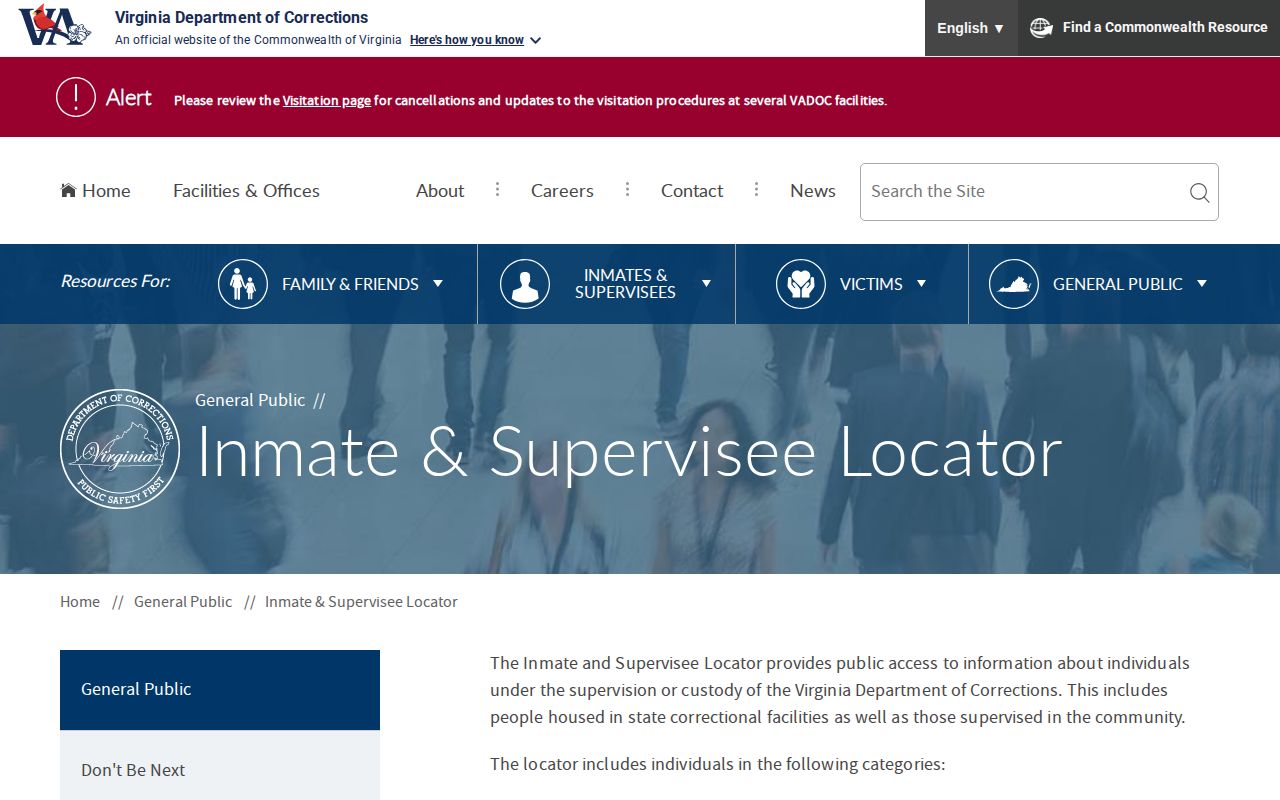
The VADOC Inmate and Supervisee Locator is the official public starting point. VADOC says the locator includes people in its institutions, on community probation or parole, in institutional hospitals, in Community Corrections Alternative Programs, and certain state-responsible people held in local or regional jails. It is updated daily, and the agency warns that information can change.
- Confirm the person’s full name, birth date, and seven-digit DOC ID when available.
- Search by DOC ID for the strongest match, or enter the required name fields and useful filters.
- Read the status, location, supervision, and date labels exactly as the live record presents them.
- Decide whether the result shows institutional custody, community supervision, transfer, release, or discharge.
- Compare the result with the Surry sentencing order and any RRJ transfer record.
- Request the existing VADOC release or time-computation record when public fields do not resolve the question.
A current-custody placement is not a released record. An inactive or missing result is also not proof of discharge because the public locator does not promise an indefinite historical display for every former person. The Surry County release search gives the alternate RRJ, court, and federal routes when VADOC is not the responsible system.
The official locator is shown in the image captured from the VADOC search page.
VADOC Locator Release Fields
The locator accepts a seven-digit DOC ID or a name search. The name route requires at least the first three letters of the first name and the complete last name. Location, race, sex, and age can narrow a match. A DOC ID is the most useful identifier because names can collide or change.
| Search field | Use | Record caution |
|---|---|---|
| DOC ID | Direct seven-digit identifier search | Confirm it belongs to the intended person |
| First and last name | Required name components | Do not match on name alone |
| Location | Narrows the current listed placement | Placement can change |
| Race, sex, age | Optional identity filters | Use only to distinguish records |
| Status or supervision | Shows the type of VADOC relationship | Copy the exact live wording |
| Release-related date | May show a calculated date concept | Do not invent or rename the displayed label |
Research did not complete a result-level check of the locator’s current release-date label because access controls prevented a clean capture. VADOC public text refers to a release date, while Victim Services uses “anticipated release date.” A facility page should therefore describe the concept without promising a field called “Projected Release Date.” The label on the matched live result controls.
- Release
- The end of institutional confinement, sometimes followed by supervision.
- Parole
- Conditional release from an eligible prison sentence.
- Probation
- Court-ordered community supervision.
- Discharge
- The formal end of a custody or supervision obligation.
VADOC Time Computation Records
VADOC computes state terms from the sentence, credit for time already confined, concurrent or consecutive structure, the governing credit system, credit class, disciplinary events, and later legal changes. A court order supplies key inputs. The online court docket does not perform the live computation. Only the responsible time-computation unit can give an authoritative estimate for an individual state sentence.
For qualifying felony offenses committed on or after January 1, 1995, Va. Code §§ 53.1-202.2 through 53.1-202.4 govern earned sentence credits. Section 53.1-202.3(A) caps listed serious offenses at 4.5 days per thirty days served. Subsection B has other eligible levels of fifteen, 7.5, 3.5, or zero days per thirty, subject to the statute’s qualifications and effective version. Va. Code § 53.1-189 allows forfeiture and governs restoration.
Virginia’s “at least 85 percent” description is shorthand for much of the post-1994 framework, not a universal formula. The 4.5-per-thirty maximum produces about 86.96 percent under a simple ratio before case-specific issues. Older parole-eligible sentences and statutory exceptions differ. A date may move after jail-credit corrections, amended orders, credit forfeiture or restoration, a detainer, or a parole action.
Note: A calculated date is not an actual release event, and the Code version tied to the offense date must control the credit analysis.
VADOC Facility Release Process
The VADOC facility-release process states that a person who has satisfied the sentence is discharged or released on parole by 11:59 p.m. on the calculated release date, weather permitting. Staff review and obtain signatures on an Order of Release and any Conditions of Probation or Conditions of Parole. The process also addresses a notification-of-release letter, documented property, account funds, transportation, and family pickup.
This statewide rule belongs to VADOC facilities. It does not establish an RRJ release hour, weekend policy, or public promise. RRJ expressly says it will not provide release information to the general public, and no local release hour was found. A Surry reader must first identify the custodian before applying any timing statement.
The paperwork also shows why “grant,” “calculated date,” and “actual release” are separate stages. A parole grant can begin planning and required notice before the person leaves. An Order of Release records authority and conditions. The completed departure and later community-supervision status confirm the practical outcome.
VADOC Release Notifications and Discharge
VADOC Victim Services uses NAAVI for eligible state-system notifications. The program may report transfer, anticipated release, actual release, parole events, escape, recapture, death, or another covered change. It is separate from Virginia VINE, which covers participating local and regional jails such as RRJ. A VINE registration made for an RRJ record does not transfer into NAAVI after a state commitment.
Notification is not a certified record. Pair a covered event with the locator, release letter, Order of Release, sentencing order, or other record held by VADOC. If a person moves from prison to probation, parole, or post-release supervision, institutional custody has ended but the legal obligation continues. Discharge is the later end of the custody or supervision duty.
The distinction matters when records show different dates. A prison release date can precede a supervision discharge date by months or years. Neither date erases the underlying court record. When the public locator and a document conflict, ask VADOC for the existing record and its current status rather than estimating from the original sentence.
Note: Local VINE and state NAAVI are separate registrations because custody events do not follow one person through every Virginia system automatically.
VADOC Release Records and Contact
For a past release, request the record from the VADOC unit that maintains it. A focused request can identify the full name, DOC ID, sentence or release period, and a specific existing record such as an Order of Release, notification-of-release letter, release-date entry, or time-computation record. Virginia FOIA does not require an agency to create a new calculation or answer a custom question.
Virginia Department of Corrections
P.O. Box 26963
Richmond, VA 23261
(804) 674-3000
FOIA questions: FOIA@vadoc.virginia.gov
(804) 963-2953
Va. Code § 2.2-3706 makes imprisonment records discretionary, so some material may be withheld or redacted. VADOC provides procedures for inactive-offender records and consent forms for confidential information. Ask for the narrow record that answers the release question, request an electronic copy, and seek a cost estimate. No flat VADOC release-record fee was established in the research.
A Surry sentencing court can supply the judgment and later orders, but it cannot certify VADOC’s current computation. RRJ can document a transfer into state responsibility, but not the completed state-prison release. Matching the custodian to the record prevents one agency’s event from being mislabeled as another agency’s release.