
Surry County Parole Versus Probation
Parole and probation both permit a person to live outside a jail or prison while following stated terms, but they begin through different legal acts. The Virginia Parole Board decides discretionary parole for eligible prison sentences. VADOC administers field supervision. Probation comes from a court order and can follow a jail or prison term, replace active confinement in part, or accompany suspended time. Post-release supervision may also be part of the sentence. It is not another name for parole.
A Surry County release record answers when physical custody ended. It does not, by itself, answer which type of supervision followed. The sentencing order, VADOC locator status, and parole records must agree before a label is used.
| Point | Parole | Probation |
|---|---|---|
| Who authorizes it | Virginia Parole Board for an eligible sentence | The sentencing court |
| When it starts | After conditional release from prison | Instead of, after, or alongside suspended confinement |
| Who supervises | VADOC community corrections | VADOC community corrections when state-supervised |
| Best public context | VADOC locator plus Board decisions when applicable | VADOC locator plus the Surry sentencing order |
| How it ends | Discharge, expiration, or another official action | Successful completion, court action, or expiration |
- Parole
- Conditional release from a parole-eligible prison sentence.
- Probation
- Court-ordered supervision in the community.
- Post-release supervision
- A supervision term imposed as part of a sentence.
- Discharge
- The formal end of custody or supervision, not erasure of the court record.
Verify Surry County Release Supervision
The official starting point is the VADOC Inmate and Supervisee Locator. It covers people in state institutions, probationers, parolees, and other people within defined VADOC programs. Search by the seven-digit DOC ID when known. A name search requires the full last name and at least the first three letters of the first name, with optional filters for location, race, sex, and age. Read the returned status and location as written.
- Confirm the full name, date of birth, and DOC ID from a reliable document before matching a result.
- Search the VADOC locator and distinguish institutional custody from a community-supervision placement.
- Record the district or location shown. Do not assign a district from geography alone.
- Open the VADOC office directory and use the result to find the published office contact.
- Compare probation with the Surry sentencing order. Compare parole with Board records when the sentence is parole-eligible.
- For an official historical record, ask the court, VADOC, or the Virginia Parole Board unit that maintains it.
A person released from Riverside Regional Jail may never enter VADOC supervision. RRJ houses local detainees and people serving local terms, while VADOC covers state prison and state community-corrections matters. If a VADOC search has no match, review the Surry criminal case and the custody-ending RRJ record rather than treating the blank result as proof.
For comparison, the broader Surry County released-inmate search path explains how RRJ, Virginia VINE, courts, and VADOC document different custody events.
Note: A community-supervision listing confirms release from an institution, but it does not show that every sentence obligation has ended.
Surry County Supervision Office Routing
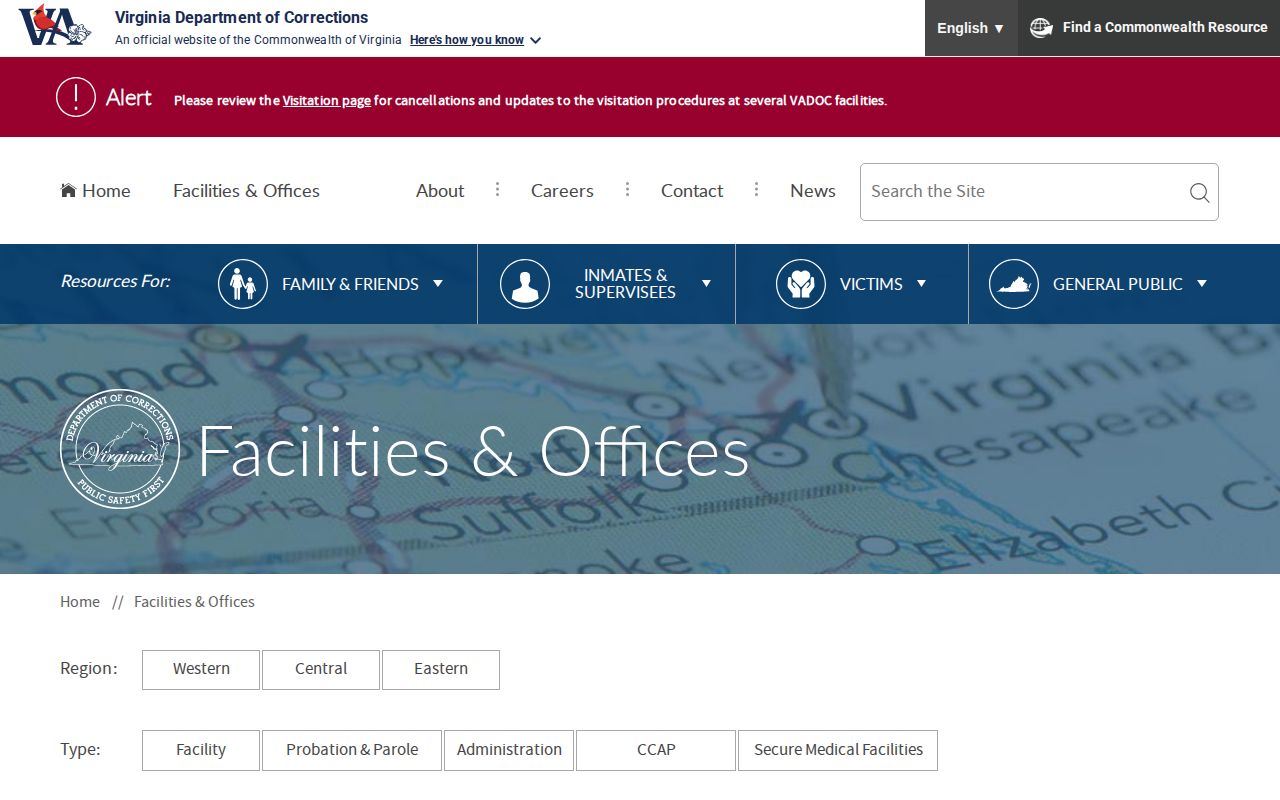
No reviewed VADOC district-office entry expressly named Surry County in its published service area. That finding matters. A nearby office must not be presented as the assigned parole or probation district. Confirm the office through the person’s locator result, release papers, supervising officer, or VADOC central office. Then use the Facilities and Offices directory for the current district address and telephone.
The official VADOC directory is shown in the image below. It is a routing tool, not evidence that one specific district serves every Surry County case.
VADOC Central Office
P.O. Box 26963
Richmond, VA 23261
(804) 674-3000
Ask how to confirm the assigned community-supervision district.
Surry County Parole Decision Records
The Virginia Parole Board, not the local jail, decides discretionary parole. Its public-meetings calendar is event-based. Since July 2024, the Board’s described process includes a videoconference with a person when it is inclined to grant discretionary or geriatric release, with the agenda posted at least three working days in advance. Not every eligible person appears at a listed public meeting, and the calendar is not a weekly release list.
The monthly parole decision reports provide a different record. Reports are posted after required notifications, at the end of the following month, and the archive spans five years. A monthly report can identify the DOC number, case type, decision and certification dates, jurisdiction, offenses, sentence information, reasons, and member votes. Published outcomes include Grant, Revoke, and Continue on Parole, along with non-grant and deferral processes.
Eligibility is sentence-specific. Under Va. Code § 53.1-151, the general legacy schedule uses one-quarter of the term or a twelve-year cap for a first commitment, one-third or thirteen years for a second, one-half or fourteen years for a third, and three-quarters or fifteen years for a fourth or later commitment. Life sentences, listed serious offenses, and exclusions have different rules. Va. Code § 53.1-165.1 abolished discretionary parole for most felony offenses committed on or after January 1, 1995, while preserving defined exceptions. Those rules make a hand-calculated eligibility date unsafe without the offense date, sentence structure, commitment history, and current Code version.
The Board’s official calendar is captured below. It helps trace the decision process, not the hour a person leaves a facility.

Surry County Supervision Violations
Conditions depend on the order and case. They may govern reporting, travel, treatment, payments, or other conduct, but a public summary should never be treated as the person’s full set of terms. Virginia law gives custodians discretion over many probation, parole, and home-electronic-incarceration records under Va. Code § 2.2-3706(B)(6). A locator may verify broad status while schedules, addresses, treatment details, and case notes stay restricted.
An absconder is a supervised person alleged to have stopped reporting or otherwise left supervision without authority. That label must come from the proper agency or court. VADOC’s Most Wanted page is selective. It is not a full warrant index, and absence there does not prove that no officer warrant, court capias, or Parole Board warrant exists. Someone checking their own status should contact counsel, the supervising office, or the relevant court. Members of the public should not try to detain or confront anyone.
Virginia VINE reports local and regional jail custody events, not the full course of probation or parole. Likewise, VADOC’s NAAVI service is an eligible-victim notification program and does not replace the locator, court order, or supervising office for status verification.
Note: Public supervision status can be useful, but confidential case details should remain with the person, counsel, court, and responsible agency.
Surry County Veteran Release Support
Riverside Regional Jail has a distinct local reentry route through its Veterans Outreach Services program. The program is for verified veterans who are scheduled for release within two years. That eligibility window makes it a pre-release navigation resource, not proof of parole, probation, or a fixed release date. A Surry County veteran held at RRJ may use the program to connect with the named support process while still in custody.
Program participation and legal supervision answer separate questions. A person may receive veteran-focused release planning without being on parole. Another person may be on probation without qualifying for the veteran program. Verify the supervision status through VADOC and the court, then treat RRJ’s outreach service as a practical reentry contact tied to the regional jail.
Surry County Pre-Release Property Rules
RRJ publishes a narrow property rule for the time before release. During the first fifteen days of incarceration, keys and bank cards may be collected by appointment. Later, the confined person must submit a property-removal form and mail all non-clothing property together at personal expense. Partial release is not allowed under that rule.
This is not a stated property-at-the-door policy. It should not be used to predict what staff will hand back when a person physically leaves RRJ. The rule instead helps a family plan access to urgent items while confinement continues. Questions about exit property, identification, funds, or transportation should be directed to RRJ through its published procedures, without asking staff to disclose a future release time.
Note: RRJ’s property-removal rule applies before release and does not establish the facility’s final property-return practice.
Surry County Supervision Discharge
Release from confinement and discharge from supervision are separate milestones. The RRJ or VADOC release date records when jail or prison custody ended. A discharge letter, agency entry, or court order can record the end of probation, parole, or post-release supervision. Until that later event occurs, the person may remain subject to valid conditions even while living in the community.
Successful completion may also open distinct Virginia processes involving pardon, clemency, or restoration of civil rights through the Secretary of the Commonwealth. Those are not automatic substitutes for a discharge record, and they do not rewrite the custody history. For a precise end date, use the controlling order or agency document. If public systems conflict, ask the record’s custodian for the existing entry instead of estimating from the original term.