
Surry County Scheduled Versus Actual Release
A projected, scheduled, or anticipated date is a calculation. An actual release is the completed custody-ending event. The calculation begins with a valid sentence and may reflect jail credit, sentence type, concurrent or consecutive terms, earned-credit class, and legal changes. The actual event happens only after staff complete required checks and confirm that no other lawful hold prevents departure.
A person awaiting trial is different. A bond ruling can authorize release if its conditions are met, but it does not create the same computed date as a sentence. RRJ must receive and process the order, check other charges or detainers, and complete its own release work. A court docket records legal authority. It is not a live jail clock.
“Detainer” means a request or legal hold from another authority. It can cause transfer to another custodian instead of release to the community. “Discharge” means a custody or supervision duty has ended, but it does not erase the conviction or court file.
Find a Surry County Release Date
Begin with the custodian, not with a date copied from an unrelated database. Surry adults in local custody generally move through Riverside Regional Jail. People committed to a Virginia state sentence may appear in VADOC, including certain state-responsible people still housed in a local or regional jail. Federal and immigration records use different systems and cannot verify an RRJ or VADOC release date.
- Check the Surry criminal case for the sentence, bond order, active confinement, suspended time, and later amendments.
- Search RRJ with “Include released inmates” for a local booking. Use Records when the public result does not establish the date or disposition.
- For a state-responsible person, search VADOC by the seven-digit DOC ID or by the required name fields and identity filters.
- Read the live result’s exact status and date label. Do not rename a generic date as “Projected Release Date.”
- Compare the result with the sentence and time-computation record. Resolve conflicts with the authority that performs the calculation.
- Confirm departure through a later custody event, release document, or agency record rather than the estimate alone.
Research did not verify the exact current date-field label on a public VADOC result because access controls prevented a clean result check. VADOC source text refers to a release date, while Victim Services uses “anticipated release date.” Copy the label shown on the actual record. Never promise that fully discharged inactive people remain searchable.
The Surry County released-inmate search provides the full RRJ, court, VADOC, and records-request route when the outcome is unclear.
Note: A blank VADOC result can mean the person has a local case, an unmatched identity, or a record outside the locator’s public scope.
VADOC Surry County Release Computation
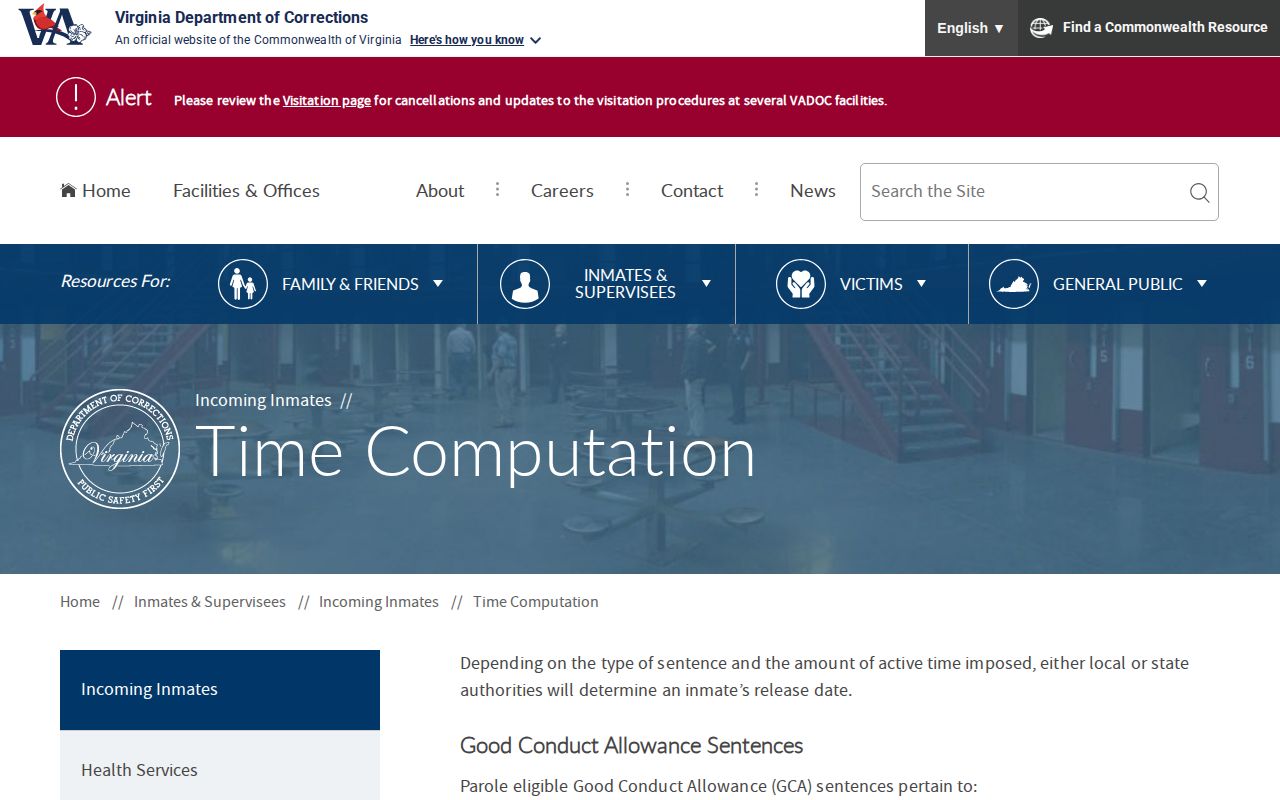
VADOC’s time-computation guidance separates older Good Conduct Allowance rules from Earned Sentence Credits. It calculates state terms from the commitment record, total sentence imposed, credit for time already confined, governing credit system, classification, and later legal events. The sentencing court supplies key inputs, but VADOC maintains the live state computation.
The official computation page is captured below. It explains the system, while an individual’s controlling calculation stays tied to that person’s sentence and record.
Va. Code § 53.1-187 generally credits time actually spent confined while awaiting trial and pending appeal for the offense. That credit can shift the computed end of a sentence. Consecutive terms run one after another, while concurrent terms overlap to the extent ordered. A changed sentencing order or corrected jail-credit entry can therefore move the displayed estimate without any misconduct.
Sentence responsibility is the key local boundary. A short Surry County sentence served wholly at RRJ may never produce a useful state locator record. By contrast, a felony commitment can enter VADOC data before the person is physically moved from the regional jail. Start with RRJ for the booking, then add VADOC only when the sentence or custody disposition shows state responsibility. This avoids treating a state calculation as the answer to a local jail question.
Surry County Earned Release Credits
For felony offenses committed on or after January 1, 1995, Va. Code §§ 53.1-202.2 through 53.1-202.4 govern earned sentence credits. Section 53.1-202.2 defines the credit and states that one credit equals one day deducted. Section 53.1-202.3(A) limits listed serious offenses to no more than 4.5 credit days for each thirty days served. Subsection B has classification levels of fifteen, 7.5, 3.5, or zero days per thirty for other eligible offenses, subject to statutory limits and the version tied to the offense.
That is why “serve 85 percent” is only shorthand. A 4.5-per-thirty maximum produces about 86.96 percent under a simple ratio before sentence-specific issues. Other eligible offenses may fall under different rates. Parole was abolished for most qualifying felony offenses committed on or after January 1, 1995 under Va. Code § 53.1-165.1, but older sentences and defined exceptions remain. No single percentage should be applied to every Surry County case.
Credits can also be lost. Va. Code § 53.1-189 permits forfeiture and governs restoration. A disciplinary event may move the estimate later, while an authorized restoration may move it back. Credits do not shorten a statutory period that must be served before parole eligibility.
Note: Always use the Code version tied to the offense date because Virginia earned-credit provisions have effective-date and eligibility distinctions.
RRJ Surry County Release Credits
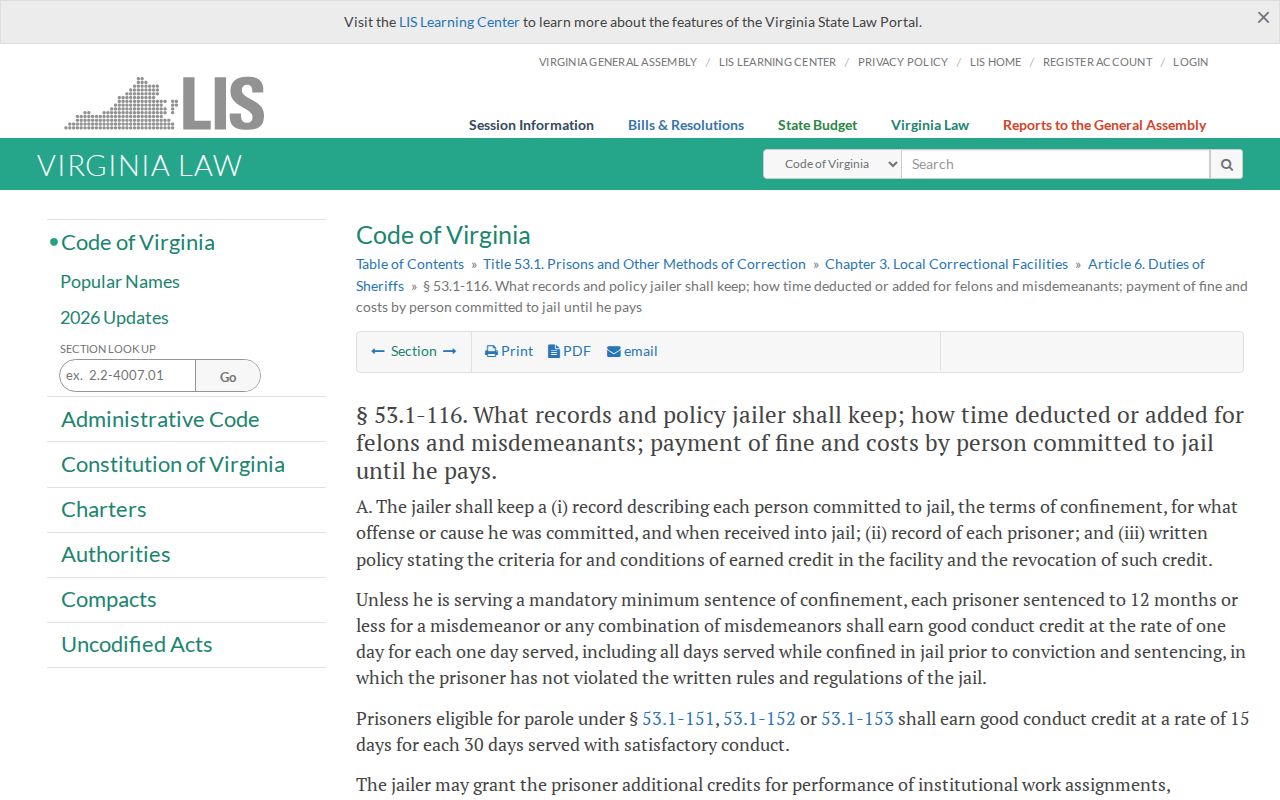
A local term at RRJ does not use a guessed VADOC date. Va. Code § 53.1-116 requires the jailer to keep commitment and prisoner records and to maintain a written earned-credit policy. Subject to mandatory-minimum and offense rules, qualifying misdemeanor aggregate sentences of twelve months or less can earn one day for each day served with compliant conduct. Qualifying pretrial days are included. The section also addresses parole-eligible people and specified optional credits, while post-1994 felony credits remain capped by the Article 4 framework.
RRJ must apply the governing statute, its written policy, the Surry commitment order, and credited confinement to the individual episode. A reader cannot safely reproduce that calculation from a docket alone. Va. Code § 53.1-129 also addresses local good-conduct allowances. Ask RRJ Records for an existing custody or computation record, understanding that RRJ’s FAQ says future release information is not given to the general public.
For a records request, identify the person, booking episode, and approximate sentence date. Ask for an existing release-date or time-computation entry and any custody-ending disposition that can be disclosed. Virginia FOIA does not require an agency to create a custom calculation or answer a hypothetical question. The existing record is more useful because it preserves the authority’s own labels and the date on which the computation was current.
The official local-credit statute is shown below. It supports the legal framework, not a promise of a particular release day.
Why Surry County Release Dates Change
A date can move for reasons that have nothing to do with a data error. Some changes alter sentence length or credit. Others keep the calculated date but prevent release to the community. The latest record must be read in chronological order, with the status and responsible authority kept distinct.
| Factor | Effect on the date or outcome | Where to verify |
|---|---|---|
| Jail credit correction | Adds or corrects time already served | Court order and time-computation record |
| Earned-credit class | Changes the rate at which eligible credit accrues | VADOC or RRJ computation record |
| Forfeiture or restoration | Moves an estimate later or earlier under governing rules | Custodian’s disciplinary and computation entries |
| Amended court order | Can change active time or sentence structure | Surry court file and corrected commitment |
| Consecutive sentence | Adds another term before release | Sentencing orders and custodian calculation |
| Detainer or hold | May cause transfer instead of community release | Custody record and holding authority |
| Parole decision | Can affect eligible legacy or exception cases | Virginia Parole Board and VADOC |
A parole grant is not an actual release timestamp. Planning, certification, and required notice take place before departure. Likewise, disappearance from RRJ’s current list may mean transfer, not release. Check the custody-ending disposition before describing where the person went.
When Surry County Release Occurs
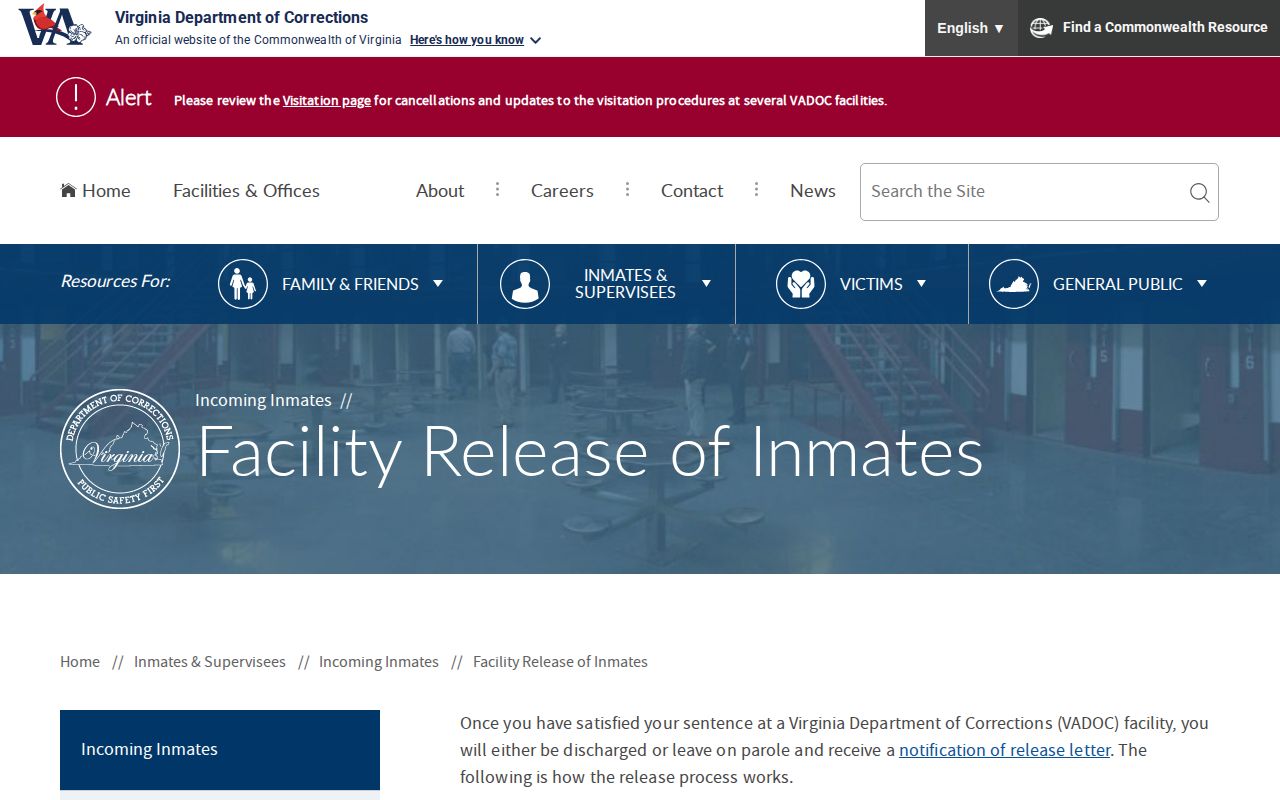
VADOC publishes a statewide facility-release rule: a person who has satisfied the sentence is discharged or released on parole by 11:59 p.m. on the calculated release date, weather permitting. Staff review an Order of Release and any Conditions of Probation or Conditions of Parole, obtain required signatures, issue a notification-of-release letter, and address property, funds, and transportation under the state process.
The VADOC facility-release guidance is shown below. It applies to VADOC facilities statewide.
RRJ publishes no local release hour or weekend rule in the reviewed material. Its FAQ says it does not provide release information to the general public, and inmates receive their dates and make their own plans. Therefore, VADOC’s by-11:59 rule cannot answer what time an RRJ release will occur. Court processing, other holds, and the jail’s own procedures remain separate.
Note: The VADOC deadline is facility-specific guidance, not a Surry court deadline and not an RRJ release-time promise.
Confirm Surry County Actual Release
For an RRJ case, Virginia VINE can report a release or transfer event sent by the regional jail. A transfer alert means another custodian may hold the person. For an eligible VADOC notification, NAAVI is separate from local-jail VINE and may include anticipated and actual release events. One registration does not follow a person across both systems.
A person-specific VINELink release check can add timely notice for RRJ custody, but it is not a certified release record. Pair the event with the RRJ record, VADOC status, release letter, or court and custodian documents. If the question is about a future date, respect the agency’s public-access limit. Request an existing record rather than asking staff to predict an hour.
Final confirmation requires two questions. Did custody end, and where did the person go? A completed release to the community, transfer to VADOC, transfer on a detainer, and discharge from supervision are different outcomes. The exact disposition controls.